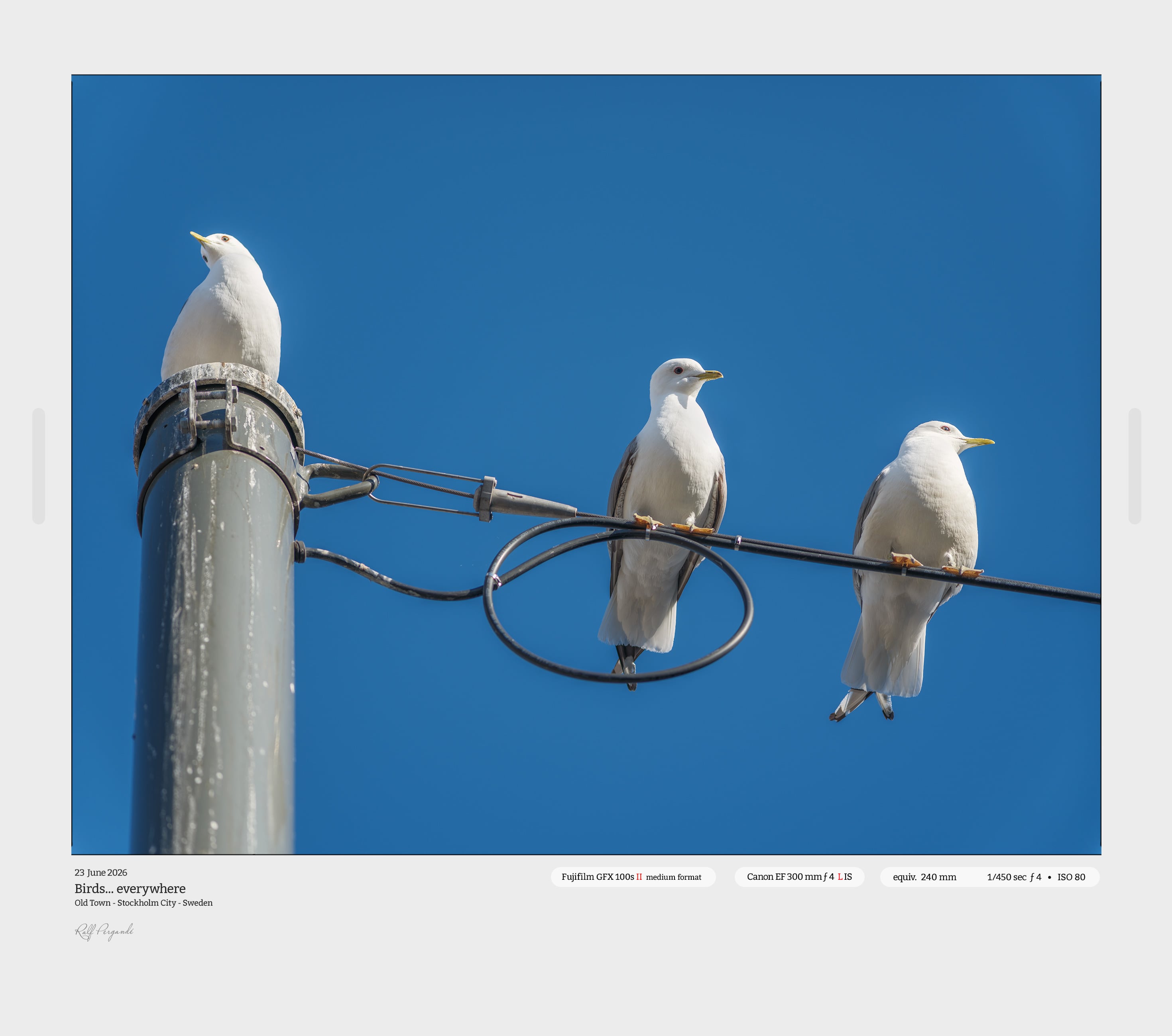
I didn't intend to do bird photography - but somehow they where so many... and funny to watch. So, of course, I took some images of them.
And had a lot of fun !
They're often pretty nervous creatures constantly flickering and flexing - but when they settle down - they just stand there - making it easier for someone totally unskilled in animal photography like me, to take images of them.
I must say, the lens really did well in that regard, although i used the more tricky wide open aperture. But it worked - and i was of course happy when i got home, seeing that most of them where in focus sharp. you have to remember, it is a 102 MP camera - sort of clumsy and behind most modern mirrorless fullframe cameras.
Working with a big chunky camera like that, is a different experience. It doesn't feel as sophisticated and deeply integrated compared to other top cameras. On top i used a third party lens via adapter... things are slower, feel a bit more unrefined / clumsy. I call it the mediumformat camera style. Everything is bulkier, clumsier and often also heavier / larger.
Yet... i simply LOVE the quality. It gives at least to some degree back the love i always had for mediumformat photography. The slower kind of work, the much larger negatives sizes. I loved, loved, loved it ! It took around 25 years between the gradual end of mediumformat cameras going to a digital mediumformat version - that can hold water.
Fuji
The camera company Fujifilm did an excellent job in creating a digital mediumformat camera. Not even Hasselblad can hold water - albeit the latter is endlessly sexy in camera design. But it is the Fujifilm GFX that delivers - and has a price advantage in their superb Fujinon GF lenses.
They have been pioneers in so many ways, when you look at the history of (unusual) cameras they have created. From "Texas-Leica" style (6x7, 6x8 and 6x9 rangefinder cameras), to the absurdly large and heavy Fujifilm GX680 studio camera (6x8 cm negative size) which was like a pimped Mamiya RZ67 camera, but with largeformat abilities (tilt, shift etc). The GX680 Pro looks more like the Belgian Bull version of the Mamiya RZ67.
Fuji even created many Hasselblad (H) lenses among others, as well the Fuji TX-1 hybrid panorama rangefinder camera - absolutely unique in the world of photography - which outside of Japan was distributed under the more well known name "Hasselblad XPan". Today, these are sold to exorbitant prices... easily reaching 7000 € for the camera body alone.
Oh, and then there where the special panorama mediumformat cameras with negative format 6x17cm. Also a legend !
So yeah. Fuji did really exceptional, out of the box thinking creations. Well, and then there is Fuji Instax... which is a worldwide, extremely successful story. Combining analog film tech with digital photography.
Happy Bird
Therefore - I am so happy that this unusual combination between Fuji GFX 100s II and Canon EF 300/4 L IS lens work so well. (Sure, I had good light conditions, easy targets, which means the difficulty bar was set to very low)
But i am happy for it anyway :-) |