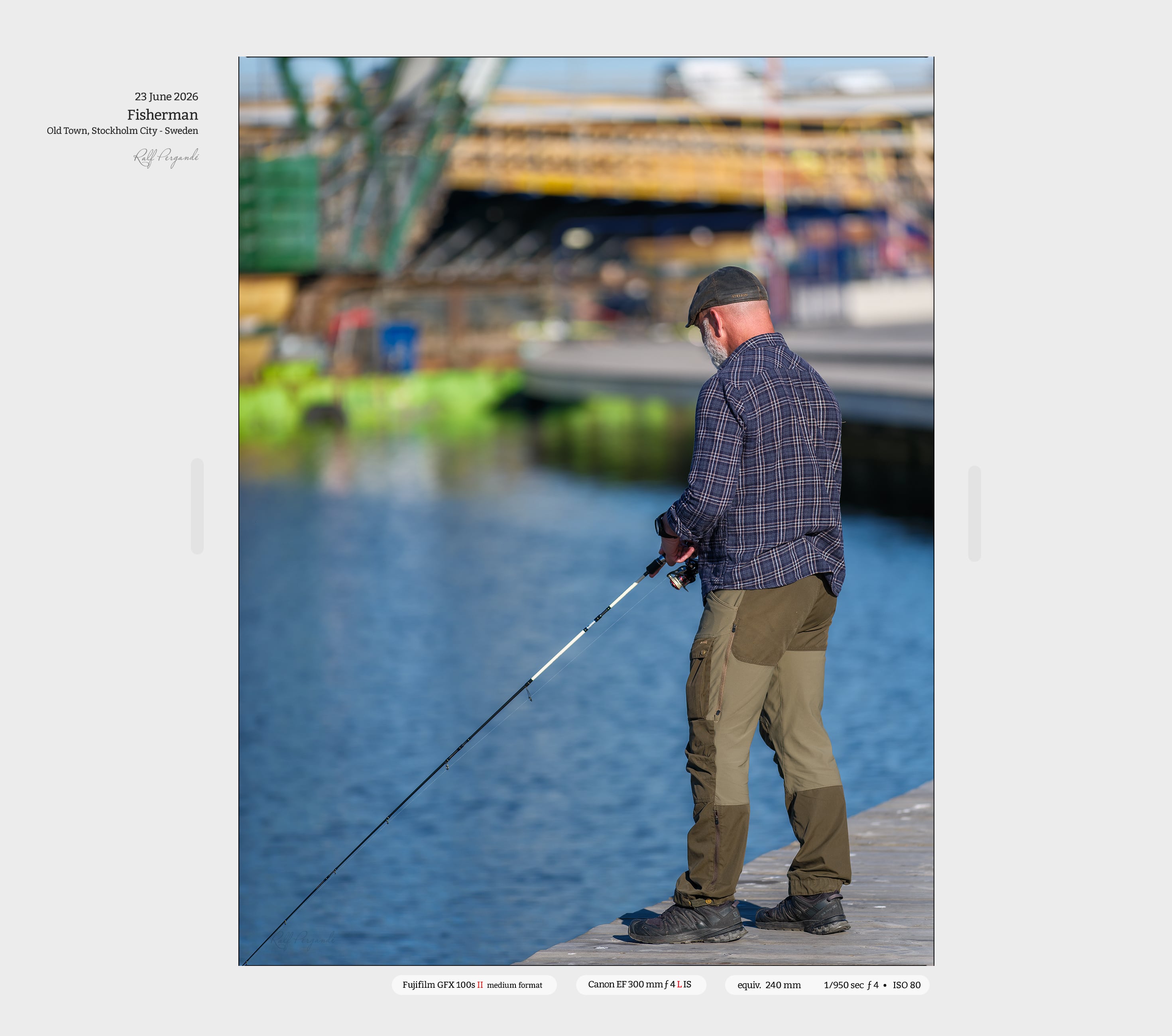
You see now, why I was happy with this lens on my morning outing ?
The performance turned out wonderful with the Canon EF 300/4 L IS on the Fujifilm GFX 100s II camera. Especially for my needs / requirements - which are less compared to professional photographers who need very large prints and other areas of interests. They usually prefer that their equipment always works nearly 100% reliable. Often they are not into a lot of corrections in images afterwards. Which I can understand from the perspective of time and money.
Well, that doesn't apply to me, now does it ? I am not doing photography for either of them.
Ironed out vignetting. Yes :-)
think the vignetting got totally ironed out in the best possible way - with help of the lens profile i mentioned on the previous page. Sharpness sits exactly on the Fisherman's neck, showing every single hair. Albeit i used a wide open aperture ƒ4 - the performance was great.
While the background blur was of course more pronounced compared to the slower ƒ5.6 lens form Pentax (150-300/5.6 ED (IF))
So, i count in the Canon EF 300/4 L IS lens as an very good performer for the Fujifilm GFX 100 system. But remember when adding vintage glass on a GFX camera; the Raw images can sometimes look very disappointing. It is the work afterwards - that counts, leading to brilliant / correct colors, with vignetting removed, and sometimes light sharpening added.
A reminder; RAW files can look "off" at first
With the Fujifilm GFX i rarely feel that the images come out "perfect" right out of the camera. For a started, most of them, come out too cold in colors... almost all of them. Which is not to my liking. Then, you have to file on the contrast, in order to get back details in shadows and in highlights. So yeah, in general, I have to work a bit more, and pay more attention and effort in dealing with RAW files coming from Fujifilm GFX cameras. |