OK. So I took the 645 Pentax-FA 80-160mm ƒ4.5 lens with me to work - but made very few images. The weather is really anything but nice; dull-darkish, windy, chilly and rainy.
That being said - the motives in a distance, where contrast poor. So, "testing" the lens on the Fujifilm GFX 100s II was suddenly a rather mixed result. The dull weather and poor contrast did lower the impression of the lens, of course.
1) • it is pretty sharp when used at 80mm (shortest/widest) focal length. It is at its worst at the longest focal length of 160mm. When using it in dark conditions, and/or in dull light / contrast poor conditions, the overall quality impression gets pulled down. It just doesn't feel so good at the longer end.
2) • in low light or contrasty light, you see plenty of fringing. Highlights like glittering droplets can produce bluish glare around those. And you have green/red/purple fringing also going on. Especially when used at the long end of 160mm, at wide open aperture. Like many vintage lenses actually do. When stopped down, things get better. (But in low light, it is unlikely you can stop the aperture down, while still having shutter speeds that result into sharp details).
3) • It works well on the Finger P645-GFX adapter - no doubt. So, I am pleased with the autofocus. Yes absolutely. [Just make sure the lens is truly locked into position when mounting it to the Fringer adapter]. You have to check that extra. Once locked - then it is really locked into position, fully secured.
4) • It is a rather fatty/bulky/heavy-ish lens. Like a crude chunk of lens. (Like many older vintage telephoto lenses are).
5) • When using this lens on a whopping 102 MP sensor - as you make the images smaller - the quality impression and sharpness do "increase" ! Things simply look a lot better and sharper - no doubt. So, don't let the fuzzier finest details betrayal you as being "bad". Put in some fine contrast increase, and when using higher ISO, some noise reduction, as well some sharpening - and things get even better, even at the soft 160mm setting (when used wide open aperture ƒ4.5 to ƒ6.3)
Be aware *grin*
Of course, this is how it usually goes. You buy cheap-ish (but well made) Pentax 645 lenses, and they bring out 85% of the goodies as a mediumformat lens - for a fraction of the price you pay for a native Fujinon GF lens.
At the same time, a sneaking feeling always swirls in your mind; and you know it very VERY WELL, that no vintage lens truly rivals the excellent Fujinon GF lenses. Ultimately, you will end up buying more, expensive Fujifilm GF lenses - because you know, they perform best. It is as simple as that.
*LOL*
Buying cheap doesn't mean it is cheap. But it will cost you ultimately more in the end. Just saying. Now that being said - it is a lot of fun to play with relatively good vintage lenses, that perform well, if you keep one eye closed. Not Fujifilm good, but damn good for being vintage lenses.
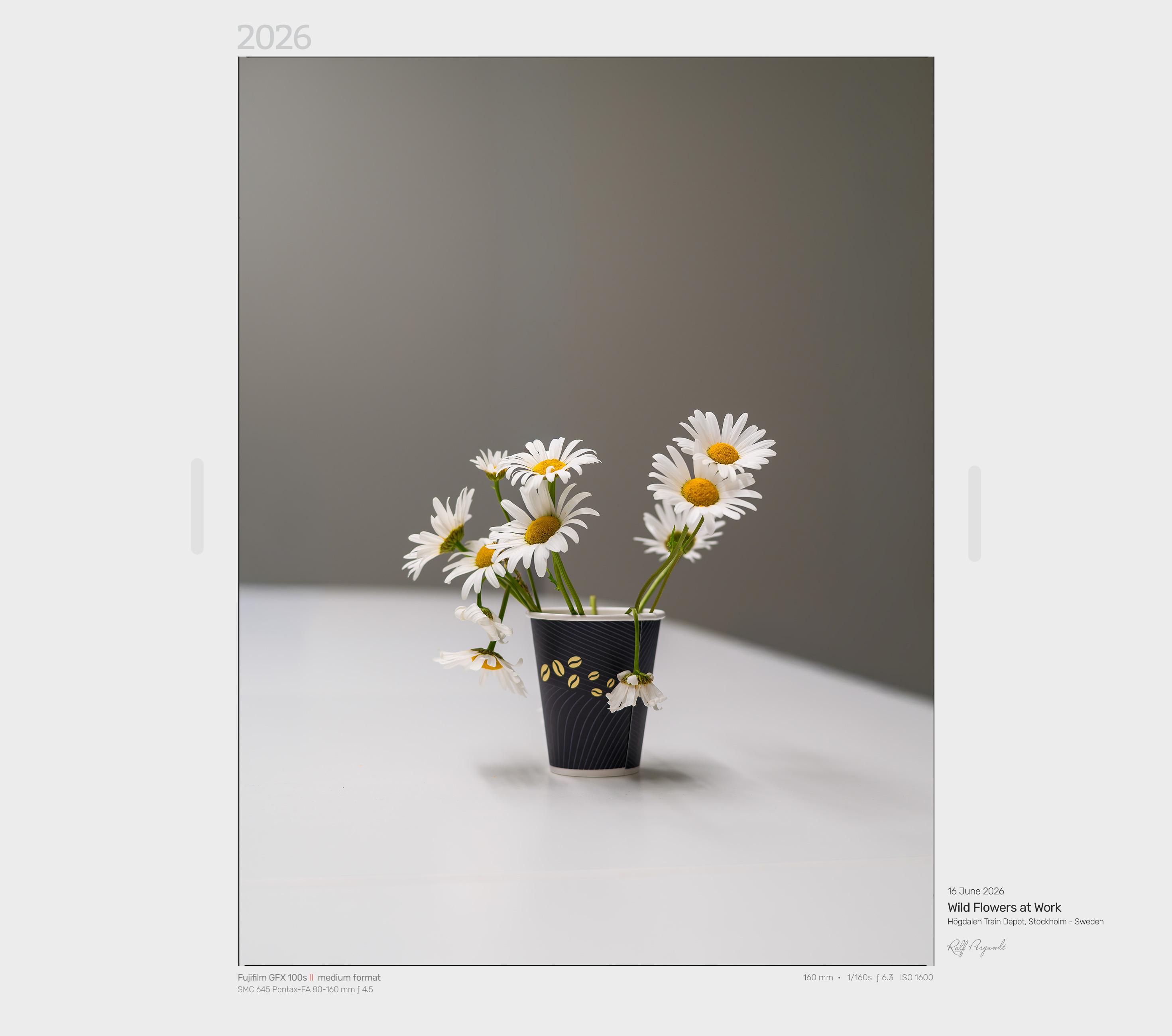
Main Photo: The Wild Flowers
Somebody of my colleagues put these wild flowers and put them neatly into a paper cup. Which is such a lovely gesture. That photo, trivial as it is - actually turned out lovely. Even if it wasn't really that sharp... but making it smaller makes it look very crisp and sharp. So, micro sharpness isn't everything, really.
For most application - even those lenses turn out as having been very good (optical) tools, in the final photo. Maybe it is a psychological thing... to know that there are truly sharp lenses, like Fujinon GF lenses. And there are vintage mediumformat lenses like from the old Pentax 645 system. Which perform admirably good, but just not as good like Fujifilm GF lenses.
But in the final, presented images... you wouldn't really think of a lightly blurry/soft rendering lens - would you?
In the end - it is the FINAL image that counts.
Not the micro sharpness performance you see at 100% from a whopping 102 MP sensor. Now of course, there are application, in which even micro sharpness is required. super large prints, perhaps. Or for high profile model agencies / covers etc. Advertising etc.
But how many amateur and semi-pro photographers are working with that ? Even a wedding photographer isn't giving 102 Million pixel images to their clients. They are usually a bit smaller. As you make them a bit smaller - things already look more sharp after post processing.
The coffee mug you see in the main photo, was in the 102 MP original file already outside of the sharpness zone. But you can't see that in the photo above.
All this reminds a little bit of the analog times, making prints from 35mm/(24x36mm) negatives vs. from 6x7cm negatives. Larger mediumformat lens where actually not as hyper sharp compared to professional fullframe lenses. Yet, 6x7cm negative automatically gave sharper looking prints due to the much larger negative size (Which you didn't had to enlarge as much, as a small negative). It also resulted into very little grain in the photo from the larger negative.
I kind of get the same vibe with the Pentax 645 lenses on a 102 MP huge sensor. The final images still look sharp, despite the lens at 160mm setting, performing with soft details only. |