That adapter is soo cool to work with Pentax 645 lenses on a Fujifilm GFX 100s II camera. You can hear the fat, chunky AF movement according to the old style AF from the 90s *LOL*
And... it works. The Image stabilization when you use a zoom, is automatically registered and adjusted accordingly. The EXIF data shows all the important parameters - including the name of the lens. Autofocus works as i said, in an old style chunky way - and sits where it has to sit.
All of the sudden, I have two wonderful Pentax 645 zooms, fully integrated into the Fujifilm GFX mediumformat system. It is incredibly cool, that for the first time in history - those lenses get new life.
Sure - they ain't optically like native Fujinon GF lenses. But with today's tools how to gently sharpen, and ease noise... you get great quality anyway. Given the large sensor size and resolution - you never notice really that you are dealing with lens from the 1990s made for the 90s analog film tech.
SMC 645 Pentax-FA 80-160mm ƒ 4.5 zoom
I used this far only the SMC 645 Pentax-FA 80-160mm ƒ 4.5 zoom. It is very sharp on the shorter end, and soft on the longest end at 160 mm (when used at wide open aperture ƒ4.5 ƒ5.6 and ƒ6.7 ). Stop the aperture down to at least ƒ8 or ƒ9.5 and it crispens up.
However, even if you use it at wide open aperture - you can skillfully cram out finest structures and sharpness quite easily. So, I don't hesitate to use it at all apertures.
In fullframe (24x36mm) terms, the zoom is equivalent to a 63-126mm ƒ 3.5 lens. So, let's just say 60-120 mm ƒ 3.5 equivalent. Not bad.
It is a chunky long lens. Again, Pentax made most of their 645 mediumformat lenses with substantial material. Therefore the lenses feel a bit hefty.
I love the adapter. Really substantial feeling and look.
Quirks / Important Notes
1) careful when updating firmware (v1.10)
However, I almost bricked the adapter when aimed to update it with the latest 1.10 firmware. So, once you transfer the firmware file into the adapter - do NOT disconnect it. WAIT 20 seconds, until the adapter dismount, and re-mounts by itself to your computer. THEN you can disconnect it, manually.
Do it earlier - and you brick it. I almost made myself in the pants, thinking that the bricking was irreversible (since the adapter didn't mount anymore, nor was recognized by the camera, and practically got unusable). I restarted my computer, and carefully several times, put the cable to the adapter and computer - until it sudden DID mount. And reapplied the firmware file into the adapter - and then just waited to do its thing. THEN it worked. So, don't give up, in case you thought you bricked it.
In the end, i managed to get the adapter updated and fully working again.
Boy, what a relief.
2) USB-A to USB-C cable
If the adapter doesn't mount - it could be the USB cable. I noticed that my USB-C native cords - which work reliable for everything else, didn't work with the adapter - as it didn't mount to the computer.
I had to use the in the box attached USB-A to USB-C cable, AND an adapter to get it to my computer ; so i used my USB-A to USB-C adapter - in order to get the adapter to mount on my computer.
A bit puzzling - but it is also stated in the manual that you may switch USB cable if the adapter doesn't mount. Use the one in the box. Hopefully you still have USB-A on your computer. If not, use an adapter, or try another cable...
VERY important Note
3) Careful check the lens attachment to the adapter is secured
I noticed occasionally that even if i thought i had attached the Pentax 645 lens to the adapter - it wasn't always. Make sure it LOCKS to the adapter securely. Otherwise you lens may / most likely fall off.
With my 645 Pentax-FA 150-300mm ƒ5.6 IF ED zoom this was even more pronounced, and i had to mount it several times, until it was really secured to the adapter mount (without turning anymore).
Be thorough to check that it has latched into locked position when you mount the lens to the adapter. Speaking of the longer zoom lens - what a pleasure to use that one !

Behind the Photo of Sal
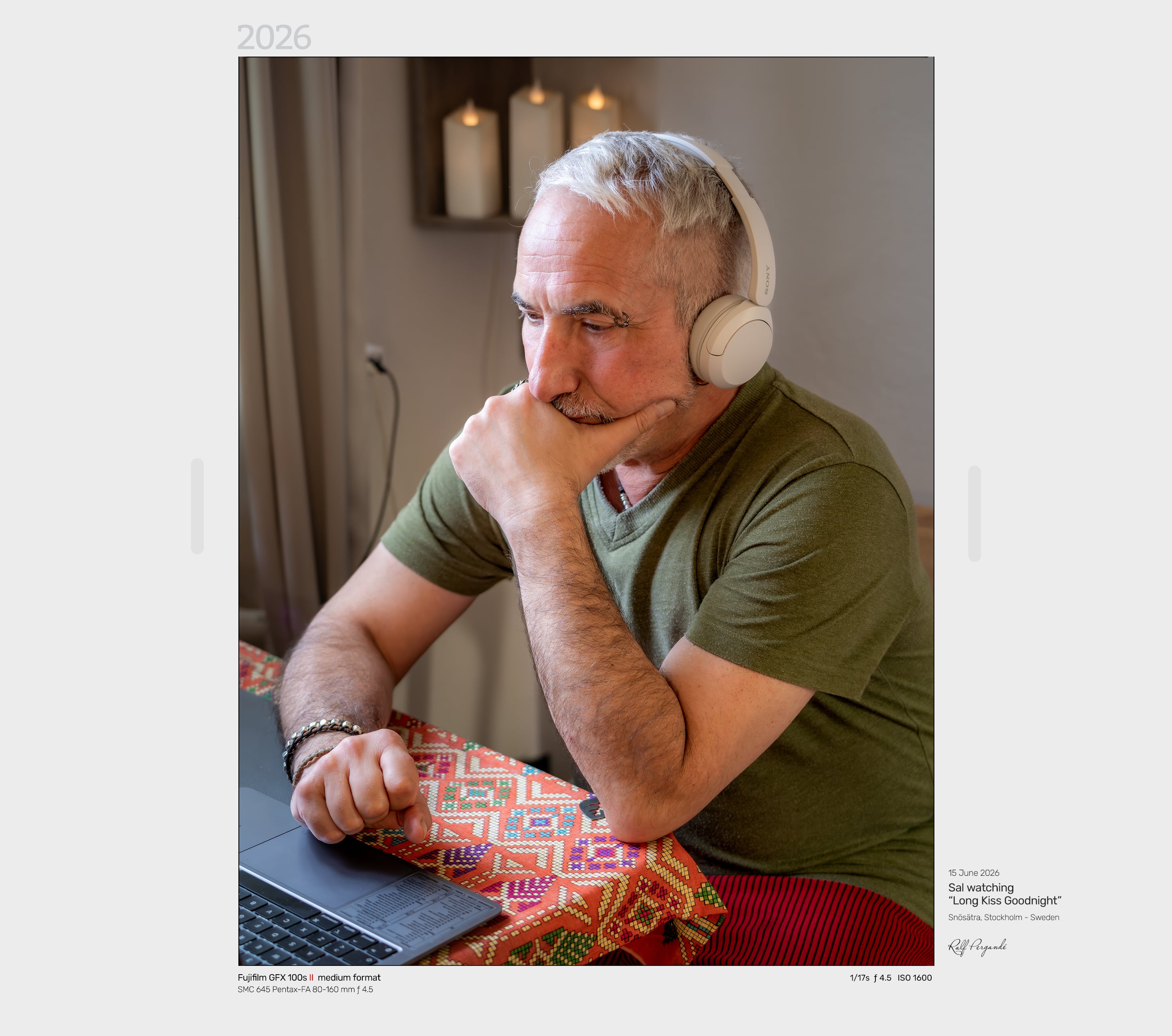
It was pretty dark indoors, in the kitchen. ISO 1600 and at wide open aperture ƒ4.5 with the zoom set to 80mm focal length. The shutter speed was really slow with 1/17 sec.
The AF hit it's correct spot. Image stabilization of the GFX 100s II was effective: Everything turned out sharp ! It is astonishing that you can handhold a 102 MP camera at a shutter speed of just 1/17 sec. Getting away with it, I mean.
I think that is absolutely awesome.
Overall - I am very excited to use my Pentax 645 AF lenses. Mainly the 80-160 mm zoom, as well the 100-300 ED zoom. Enabling nice telephoto photography with AF and automatic image stabilization regardless to which focal length i zoom into - it will be adjusted automatically / accordingly.
Incredibly cool !!!
I haven't used my manual Pentax 645 lenses, yet. Well, that's just the Pentax-A 150/3.5 lens in question. My other lens, the 645 Pentax-A 45mm ƒ3.5 - isn't really good on a digital sensor. I like it on film negatives- but not on a digital sensor.
Anyway, I use my Tamron SP 45mm ƒ1.8 lens, and the fantastic Fujifilm GF 55/1.7 lens - no need for a Pentax 645 version.
Additionally, I have the Pentax-FA 645 120/4 Macro lens with autofocus - but here I usually work with manual focus most of the time (often on a tripod).
What Fringer says about IBIS (Image stab) with following lenses:
I read in the manual that the usefulness of the adapter is a bit limited with that lens. Ah here - it says following:
* IBIS may not work well with these lenses as the focal length recognized may be incorrect. This is a limitation of the lens design.
Goes for following lenses:
• SMC Pentax-A 645 45mm F/2.8 *
• SMC Pentax-A 645 75mm F/2.8 *
• SMC Pentax-A 645 120mm F/4 Macro *
• SMC Pentax-A* 645 300mm F/4 ED [IF] *
• SMC Pentax-A 645 45-85mm F/4.5 *
• SMC Pentax-A 645 80-160mm F/4.5 *
Notice that the above lenses in question are 645 Pentax-A lenses. Those are manual focus lenses, not the "FA" autofocus versions.
|