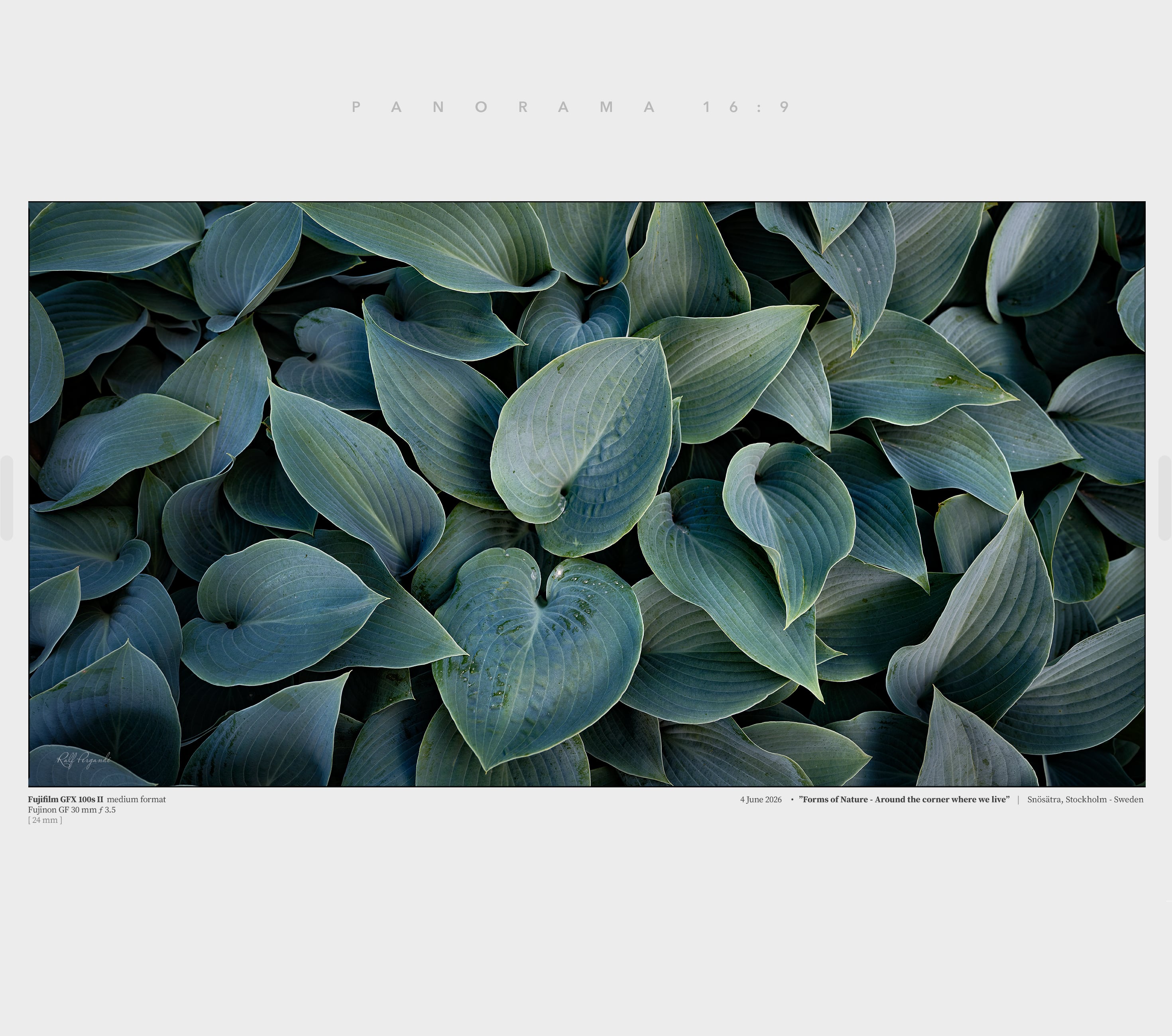
( from my Shadow Diary)
Amazing GFX 100s II
It really is. Like a GFX 50s II but with the essential, most important aspects - improved. Focus now works almost always reliable, as well faster, especially interesting when AI motives are selected (with the right settings). The Eye focus on a person, as well on a dog - ah... simply wonderful ! (I have mainly only used it in single AF-S mode) - and boy did it make life easier compared to the Fujifilm GFX 50s II camera.
Focus on third party lenses
The same goes for third party lenses, which in my case are mainly Canon EF lenses (and one Tamron lens), adapted via the best (read; most reliable) adapter on the market; the Fringer EF-GFX PRO.
The struggling Canon EF 40/2.8 pancake on my GFX 50s II - now finally works reliable with the new camera. I have not yet tested the color-shift in the extreme corners. The GFX 100s II has a backside illuminated sensor - which from what I understand, are less prone to coloration in the extreme corners.
It is such a pleasure.
When your favorite professional camera suddenly becomes a real reliable AND much more flexible tool. Then it is pure joy.
I love my old GFX 50s II. I think the 51 MP sensor is perfect and not too heavy to work with, and has all the flexible goodies that comes from that mediumformat sensor (RAW files).
Despite the doubling of pixels to 102 million - the newer sensor too is amazing. Who would have thought. It is all true what people have written and said; it is simply excellent. Remember, if you cut this sensor down to a fullframe sensor (24x36mm) - the so called 35mm setting - then you are still dealing with a whopping 60 MP !
So, despite all that - the sensors smaller pixel pitch, still delivers excellent quality images, down the finest details while keeping the noise in check. I have absolutely not problem to use ISO 3200 on this huge sensor. And wouldn't hesitate to use ISO 6400 either. Especially when you use Adobe's Noise AI - an ISO 3200 looks like that from ISO 100-200.
(I know this already from the high density sensor from the Olympus OM-1, which is equivalent to a 80 MP (!) sensor in fullframe - and would result into even more than 102 MP, if you would scale it up to 33x44mm sensor size.
Heavy files
My computer really has to work a lot harder and gets warmer (MacStudio M1 Max). Luckily not all task are that "slow" - but converting and Noise AI definitely take longer time. The latter takes 45s on my computer, instead of 25s.
The image quality is absolutely stunning.
The latitudes are vast. The noise is very low and the sensor tolerates higher ISO very well. Boy, it really is one hell of a fine sensor, with excellent qualities in many regards.
Intriguing.
The female photographer from the previous page - Victoria - i can only agree with her enthusiasm !! Her passionate words - I fully agree ! First I thought she was a bit over the top.
But no, the image quality IS actually that good !
And I do come from another mediumformat camera (which she didn't) - but the Fujifilm GFX 100s II is truly impressive. (Let me remind you that I didn't have super expectations. I kept those in check and thought; the 100s II should be better in the AF department. That was my main expectation... And as long a sensor doesn't do banding, I am totally on board with those 102 million pixels.
I do NOT compare this camera to fullframe cameras !
Fujinon GF lens performances
Sharp. Sharp. Sharp. Even on a sensor with double the megapixels... it is all sharp.
Almost unreal to be honest.
OK. Nuff' said.
|