Jupp.
I did it.
It is on order.
Payoff plan for 3 years (planned to be paid off in 1.5 years). Currently Fujifilm offers a rebate on the model here in Sweden (and Europe too, I assume), which pulled the price down by 8% - which made the price difference compared to a second hand body (via mpb.com) relatively small with around 500 €. So, therefore I prefer to buy it new here in Sweden, with a Swedish guarantee attached to it.
Plus that i can have a pay-off plan, which always fits me better and makes things more flexible. It is a little bit like working for a goal - while at the same time, always making the debts go less. (credit cards tend to be the opposite in real life - just bobbing around with "eternal debt" if you punched it too deeply).
No thanks.
So, no - I didn't touch my expensive credit card - which i just ha refilled to almost 0. That thing I don't touch anymore, because of the really excessive interest rates, and the risk of that it is too easy to not paying it off - just interests.
Been there, done it twice. No more.
What does a GFX 100s II mean ?
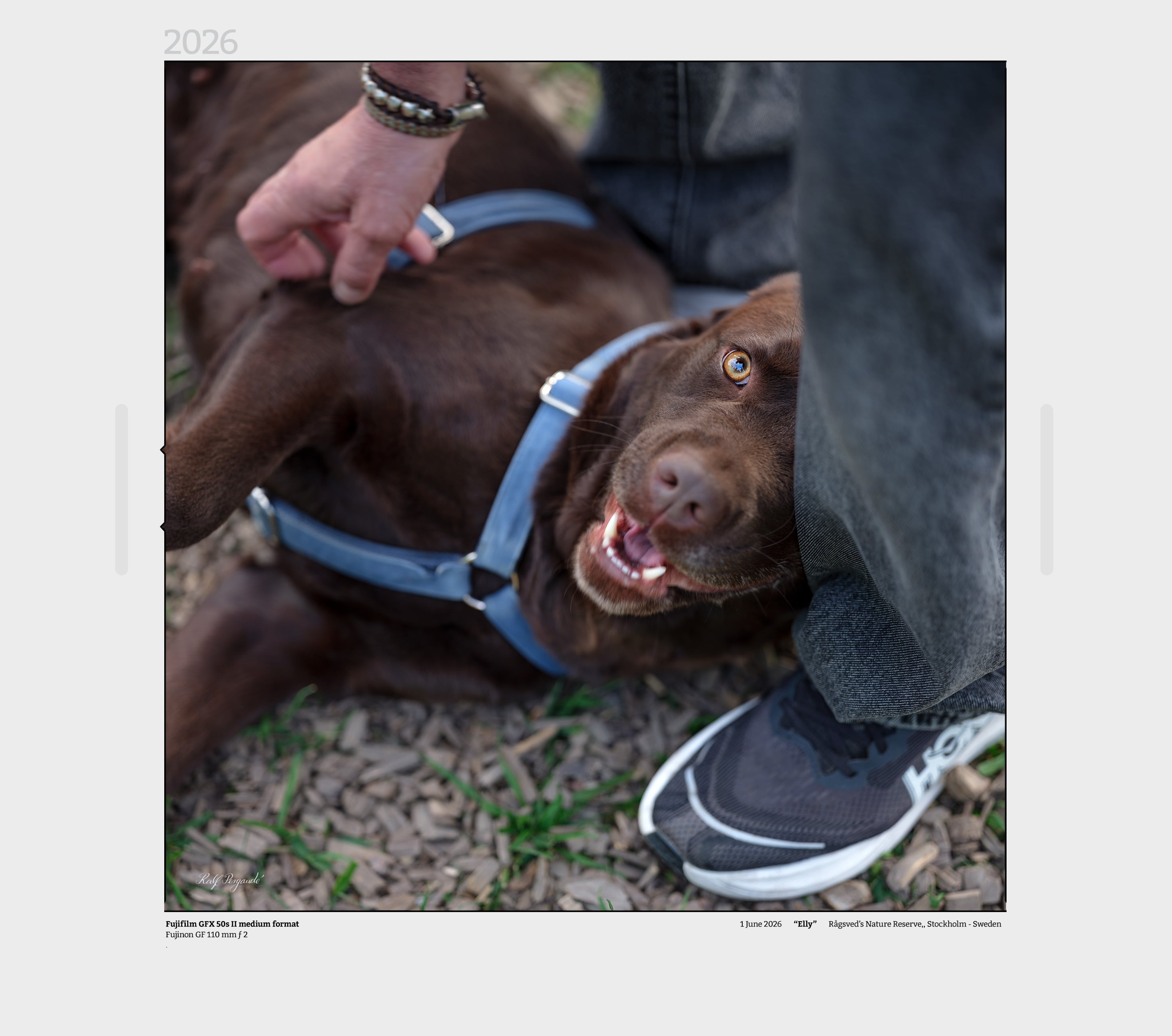
The GFX 50s II I have now, has only contrast based autofocus - so called CDAF. That is fine for slow photography of many things. Sometimes it focuses wrong, especially if you get sloppy / too fast - or/and the contrast is too low.
In principle; I do like the 50s II camera in many ways - very much in fact. Yet - never has there been a 51 MP sensor made with PDAF. Only slower contrast based CDAF. So, the only road to better AF, is to go up to a 102 MP camera.
The GFX 100 II and 100s II are the models on top of the game when it comes to AF among all mediumformat cameras. (Not to be compared with fullframe cameras of course - which are still way ahead of the GFX). People who use the 100s II where positive about the AF enhancements over the GFX 50s series, thanks to the new PDAF capability.
Existing Fujifilm GFX 50s II
will serve as a digital duplication camera for 6x7 and 6x6 film negatives
It also serves as my special "Vertex" stitching adapter camera: creating 6.5 x 6.5 cm large sensor images, using the entire image circle of Pentax 6x7 lenses natively (as if you had a real 65x65mm sensor). It then creates 120-150 MP images.
If I would do the same with the GFX 100s II camera, I would end up with extreme 300 MP images... which is just too much. For the creation of Vertex 6.5 x 6.5 cm images with Pentax 67 lenses - i don't need autofocus, as everything is done manually. There, the Fujifilm GFX 50s II is the perfect match for that type of photography.
Well, and it serves as a backup camera.
In short
• Better AF (autofocus) !
• Easier AF in the studio
• Enhanced Image stabilization (up from 6.5 to 8 stops)
• Better AF at lower light levels (GFX 50s II fails here)
• Less Moire
due to 102 MP resolution
• Hasselblad 6x6 square images "on-the-fly", due to high resolution (102 MP sensor)
• higher viewfinder resolution
• overall faster processor
• continues to use SD cards (which I prefer)
• Subject recognition (eye | animal, bird, cars, Motorcycle & Bike, Airplane, Train)
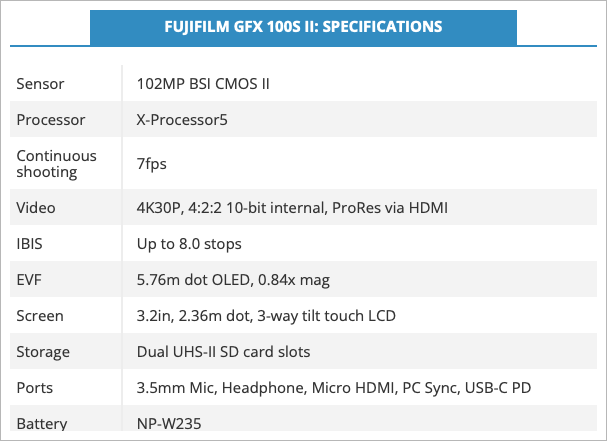
Fujifilm GFX 100s II Review by amateurphotographer.com
Ergonomics:
The GFX 100s II is basically very similar (or same) like the body of the GFX 50s II camera. It means relatively "compact" as well lighter compared to the "top" model, the GFX 100 II. They just updated some key components - but kept the same layout from the GFX 50s II model. If there are other changes, I will notice later, once I work with the new camera. I can't tell that from theory now.
Low light AF
I also heard that it acquires better AF in low light compared to the GFX 50 Series. I was surprized how easily the GFX 50s II quit on me despite the very bright GF 55/1.7 lens when the light was moderately dull. So, it would be very welcome if the GFX 100s II does better.
Bonus: Third party adapters + lenses
Both my current Fringer EF-GFX Pro adapter (for Canon EF lenses on GFX), as well the upcoming Fringer P645-GFX adapter (Pentax 645 AF lenses on GFX) - will both show better autofocus performance due to the PDAF in the newer camera !
That will be very interesting to see, how well and/or different third party AF lenses will work on the newer GFX 100s II.
Exciting !
Continued AF (AF-C)
Here an article about AF-C in the original GFX 100 vs newer GFX 100s II: A model is moving, and shows you how capable the both camera generations are in the AF-C department.
The GFX 100s II is indeed capable to follow a subject and keep it sharp.
Not bad. |